
 Por Francisco Javier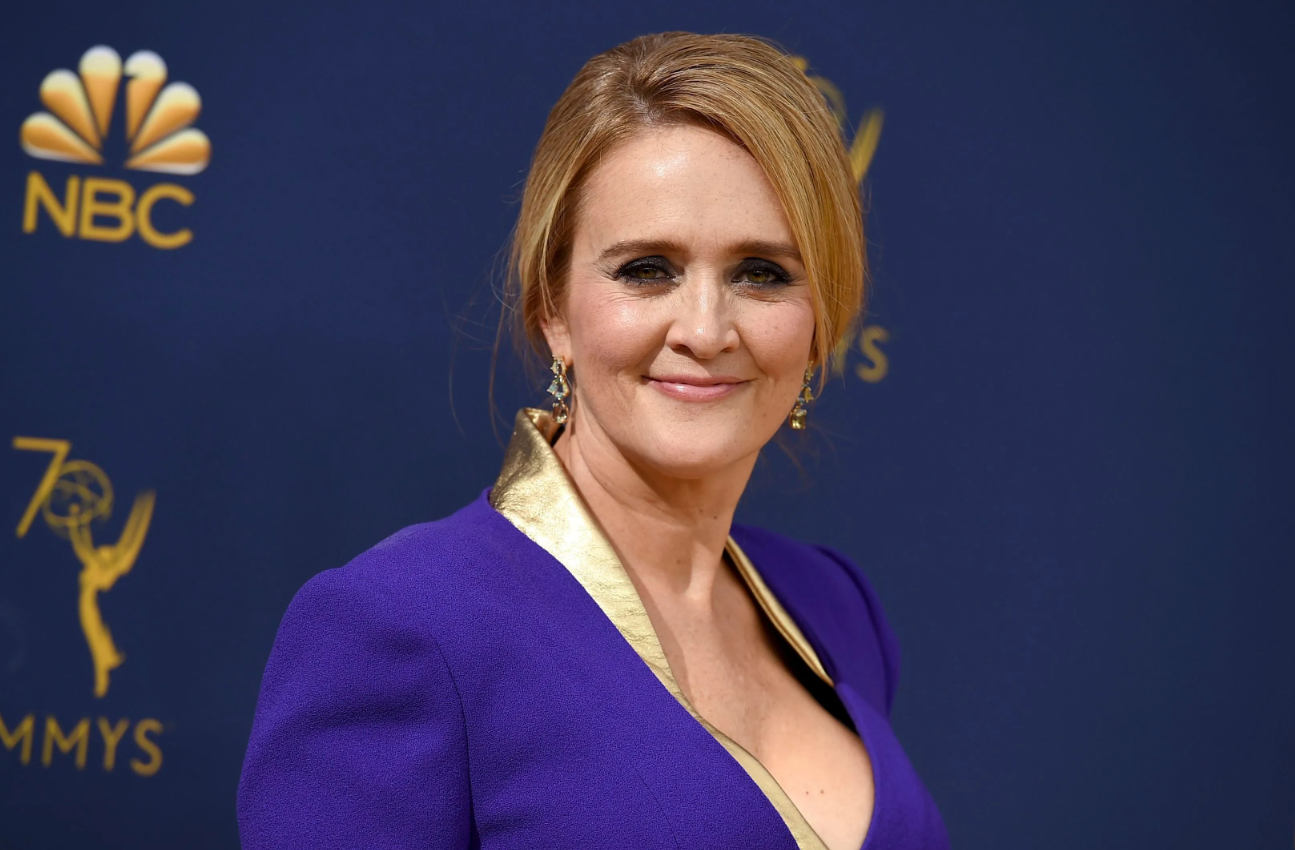
Samantha Bee became one of the most recognizable voices in North American political comedy through a career built on satire, interviews and an energetic willingness to confront political contradictions. After spending more than a decade as a correspondent on The Daily Show, she created Full Frontal with Samantha Bee, becoming one of the relatively few women at the time to host a major American late-night political comedy program. Her work combined jokes with research-heavy segments about elections, government policy, social issues and media. The result was a style of political comedy that was deliberately opinionated rather than detached.
From Toronto to Comedy
Samantha Bee was born on October 25, 1969, in Toronto, Canada. Her path toward comedy was not entirely straightforward, but she eventually became involved with Toronto’s performance scene and joined the sketch-comedy troupe The Atomic Fireballs. These experiences allowed her to develop the improvisational skills and comic timing that would later become essential to her television work.
Bee’s Canadian background remained part of her public identity even after her career became closely associated with American politics. Moving between the two countries gave her an unusual perspective on American institutions and political culture. She could participate in the country’s media environment while sometimes approaching it with the observational distance of someone who had grown up elsewhere.
The Daily Show
Bee joined The Daily Show with Jon Stewart in 2003 and became its first regular female correspondent. The program was entering an especially influential period, using comedy to examine American politics, cable news and the presidency. Bee’s segments frequently involved interviews in which she adopted an apparently straightforward persona before gradually revealing contradictions or absurdities in the subject being discussed.
Her willingness to commit fully to a comic premise made her particularly effective in field pieces. Bee could appear polite and curious while asking increasingly uncomfortable questions, allowing interview subjects to expose aspects of their own arguments. Over more than a decade, she became one of the program’s longest-serving correspondents and developed a recognizable identity independent of Stewart.
Creating Full Frontal
Bee left The Daily Show in 2015 and launched Full Frontal with Samantha Bee on TBS the following year. The program gave her the opportunity to move from correspondent to host and establish a format built specifically around her perspective. Unlike traditional late-night programs centered heavily on celebrity interviews, Full Frontal devoted considerable time to political monologues, investigative field pieces and detailed examinations of policy.
The timing of the show’s launch was significant. American politics was entering the intensely polarized period surrounding the 2016 presidential election and Donald Trump’s presidency. Bee’s comedy reflected that environment and made no attempt to disguise its political point of view, particularly on issues involving women’s rights, immigration, elections and the behavior of political institutions.
A Different Kind of Late-Night Host
Bee’s presence mattered because American late-night television had historically been dominated by male hosts. Full Frontal demonstrated that a woman could lead an explicitly political comedy program without simply imitating the established format of male late-night personalities. Her presentation was fast, confrontational and frequently angry, using outrage itself as part of the comedy.
The program also devoted attention to subjects that received relatively little coverage elsewhere in late-night entertainment. Longer segments could examine state-level legislation, voting rules, reproductive rights or international issues that did not naturally lend themselves to a conventional punchline. Comedy remained the method of presentation, but the research behind many segments gave the program characteristics of political commentary and explanatory journalism.
Controversy and Criticism
An aggressive satirical style inevitably generated controversy. Bee faced particularly intense criticism in 2018 after using a vulgar insult while discussing Ivanka Trump, leading to widespread debate and an apology from Bee. The incident illustrated the complicated standards surrounding political comedy, where deliberately provocative language can create attention while simultaneously overwhelming the argument a comedian intended to make.
Supporters of Bee often valued precisely the qualities that critics found excessive. They saw her anger as a response to political issues that she believed deserved urgency rather than detached humor. Critics, however, argued that the program could become too partisan and that its comedy sometimes functioned more as political advocacy than satire. That tension remained part of Full Frontal throughout its run.
The End of Full Frontal
Full Frontal with Samantha Bee continued for seven seasons before TBS canceled the program in 2022. Its ending came during a broader period of restructuring within television, when networks and streaming companies were reconsidering the economics of late-night and comedy programming. The cancellation ended one of the most distinctive political satire programs that had emerged during the Trump era.
Bee nevertheless left behind a substantial body of work demonstrating how political comedy had changed during the 2010s. Late-night television was no longer simply about monologues followed by celebrity interviews; programs could combine comedy, activism, field reporting and detailed policy discussions. Bee was one of the performers who pushed that transformation forward.
Beyond Late-Night Television
Samantha Bee’s career cannot be reduced to a single program. Her years on The Daily Show established her as a skilled satirical correspondent, while Full Frontal demonstrated that she could build a political comedy format around her own voice. She has also worked as a writer, producer, performer and podcast host, extending her career beyond conventional television.
Her importance is especially visible in the opportunities that followed for women in political comedy. Bee did not single-handedly transform late-night television, but her success challenged the idea that the format needed to revolve around a familiar male-host model. Whether audiences agreed with her politics or not, she created a distinct space in American satire and used it unapologetically.